

Choose your country and language
Language

CONTENTS
In simple terms, soldering is a process of joining two or more pieces of metal while allowing electricity to flow through the connection.
Unlike welding, soldering does not melt the workpieces themselves. Instead, a material acting as a kind of metallic glue is added between the two pieces. This metallic glue is called solder.
Solder is melted to create a connection between two pieces of metal and typically consists of a mixture of tin, silver, copper, and flux material.
Flux — current selection; check compatibility is a resin-containing substance added to solder to improve the solder joint.
Flux — current selection; check compatibility is usually embedded in small channels in the solder wire, so it melts onto the joint slightly before the solder melts. This cleans the soldering surfaces and also protects the molten solder from oxidation.
Lead was also used in the past, but has increasingly been phased out because it is harmful to health.
A soldering iron is a handheld tool connected to a voltage source. The soldering iron has a tip at one end that can reach high temperatures of up to 300–400 degrees.
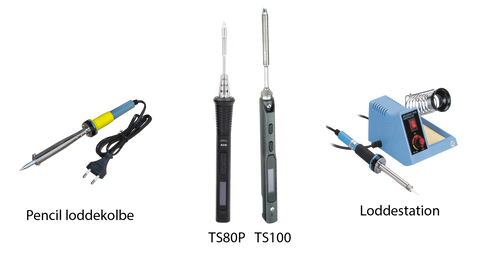
There are many types of soldering irons for different applications. At ebits.dk, we sell some of Miniware’s portable soldering irons, such as the TS100 — current selection; check compatibility and TS80P — current selection; check compatibility, both excellent soldering irons for common hobby soldering tasks. There are also soldering stations, often a permanent fixture in a hobbyist’s workspace because they are well suited to longer soldering sessions. In addition, pencil soldering irons are very inexpensive and make a fine beginner’s soldering iron.
The first step in good soldering practice is applying the correct, optimal amount of solder. The image below shows examples of the optimal amount, too much, and too little. Getting the right amount often comes with experience, so it is simply a matter of practice and repetition.

If a solder joint is less than ideal, it can sometimes make sense to remove the solder and redo the joint. To remove solder, use desoldering braid.
desoldering braid placed over the workpiece, then place the soldering iron tip on the desoldering braid, once the workpiece and the desoldering braid have reached the right temperature, the braid will automatically draw the solder from the workpiece.
The illustration above is also covered in broad terms in the video if you prefer a more visual explanation of good soldering practice.
Cold solder joints are poor-quality joints that can be caused by, among other things:
A good solder joint should wet the surfaces well and form a smooth transition to the workpieces. Lead-free joints can be matte; shine alone does not show whether the joint is sound. Cracks, poor wetting, or movement during cooling can indicate a poor joint
When solder simply drips off the tip, it indicates that the soldering tip needs cleaning. When flux and oxidation build up over time, heat is not transferred as effectively and solder does not wet or flow over the tip properly. The solder tends to melt but simply drips off the tip. This makes it difficult to move solder from the tip to the two workpieces. One solution is to clean the tip.
The soldering tip’s life is considerably extended if the tip is kept “wet” (coated with solder). A “dry” tip loses its protective coating more quickly, exposing the bare copper. As noted above, this condition also makes transferring solder from the tip to the workpiece more difficult. One preventive measure is to clean the tip after each joint to remove the remaining flux. A soldering iron stand with a damp sponge, or a deluxe soldering tip cleaner, can be used.
Guide to Cleaning the Tip:
Through-hole technology (THT) is a technology in which components have leads that are inserted into holes in a circuit board, such as stripboard. These components are described as through-hole components.

There is a fundamental difference between surface-mount technology (SMT) and a surface-mount device (SMD), because one is a process and the other is a device. SMT is a process and method for placing small components (SMDs) on a printed circuit board (PCB). A quantity of solder paste is applied to the board. The SMD component is then placed on the circuit board. When the board is heated, the solder paste melts and surrounds the components on the circuit board. This allows very small circuit boards to be produced
The video below is an example of SMT:
SMD is the designation for an electronic component designed and sized for mounting on the surface of a printed circuit board (PCB).
Language

Comments (1 comment)
Det hedder ikke ligge og ligges, men lægge og lægges:
“og ligge en ny. For at fjerne en lodning anvendes Sugetråd.
Sugetråd ligges over emnet og derefter ligges loddekolbenspids på"