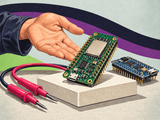





Lesson Objective
In this lesson, we will explore the AHT10 Temperature and Humidity Sensor, an essential component in your IoT air quality monitor. By the end of the lesson, you will understand what the AHT10 sensor is, how it works and why it is suitable for measuring environmental data in this project.
List of Required Components:
![]() |
AHT10 high-precision temperature and humidity sensor |
![]() |
TTGO T-Display ESP32 16MB with WiFi, Bluetooth and 1.1" colour LCD screen |
![]() |
Dupont cables, 40 pcs |
What Is the AHT10 Sensor?
AHT10 is a high-precision, fully calibrated digital sensor designed to measure both temperature and humidity. It combines accurate measurements with a compact design, making it ideal for IoT applications.
Key Features of AHT10:
- Temperature Range: -40°C to 85°C with a typical accuracy of ±0.3°C under the conditions specified in the datasheet; this does not necessarily apply across the full temperature range.
- Humidity Range: 0% to 100% relative humidity with a typical accuracy of ±2% rH under the conditions specified in the datasheet; this does not necessarily apply across the full humidity range.
- I2C Interface: Uses the I2C protocol for communication, simplifying wiring and programming when connecting to ESP32.
- Low Power Consumption: Suitable for battery-powered IoT devices and long-term use in remote environments.
How Does the AHT10 Sensor Work?
The AHT10 sensor works by using a specialised polymer capacitor to measure relative humidity and integrated temperature measurement. Here is an overview of how it operates:
- Humidity Measurement: The sensor detects changes in capacitance as moisture levels in the air vary, enabling it to calculate relative humidity.
-
Temperature Measurement: The sensor’s integrated temperature measurement detects ambient temperature. See the manufacturer’s datasheet for conditions and accuracy curves.
The sensor then digitises these values and communicates them to ESP32 through the I2C interface.
Why Is the AHT10 Sensor Ideal for Our Project?
The AHT10 sensor is an excellent choice for our IoT air quality monitor because it combines precision, low power consumption and easy integration. Here is why it is a perfect fit:
- Accurate Measurements: The sensor provides reliable readings, which are essential for environmental monitoring.
- Compact Design: Its small size makes it easy to integrate the sensor into any IoT project without taking up much space.
- Simple Communication: Using I2C makes it easy to connect the sensor to ESP32, with only two pins required for communication, reducing circuit complexity.
How AHT10 Fits into Our Project
Data from the sensor will be processed by ESP32 and either displayed on the TFT screen or sent to a web server for remote access.
The Sensor’s Role in the Project:
- Data Collection: AHT10 will continuously monitor the environment and collect temperature and humidity data.
What Comes Next?
Now that you understand the AHT10 sensor and its role in the project, the next lesson will introduce the TTGO T-display TFT screen, its features, drivers and communication protocols.
Key Points:
- AHT10 is an accurate, energy-efficient sensor for measuring temperature and humidity, making it ideal for our IoT air quality monitor.
- It communicates with ESP32 using the I2C protocol, simplifying wiring and coding.
- In the project, the sensor will collect real-time environmental data that is displayed locally and shared over WiFi.
In the next lesson, we will start connecting hardware, including AHT10, to ESP32. Let’s move on to assembling the system!


